
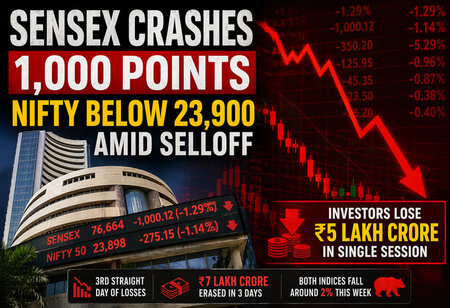
The Indian stock market continued its downward trajectory for the third consecutive session on Friday, April 24, 2026, with benchmark indices witnessing sharp declines amid weak global cues and heavy selling in IT stocks.
Key Highlights
- Sensex crashes 1,000 points; Nifty slips below 23,900 amid IT selloff and global concerns.
- Investors lose Rs 7 lakh crore in three days as market sentiment weakens sharply.
The BSE Sensex plunged over 1,000 points, or around 1.3%, to close at 76,664, while the Nifty 50 dropped 275 points, or 1.14%, settling at 23,898. The broader markets also remained under pressure, with the Nifty Midcap 100 falling 0.96% and the Smallcap 100 declining 0.87%.
The selloff was largely driven by weakness in the IT sector, with stocks such as Infosys, TCS, Tech Mahindra, and HCL Tech emerging as the top losers on the Nifty 50, declining between 4% and 7%. In contrast, Coal India, Trent, and Hindalco managed modest gains of up to 1%. Overall market breadth remained negative, with 38 of the 50 Nifty constituents ending in the red.
Sectorally, the Nifty IT index was the biggest laggard, crashing over 5%, while Media and Pharma indices declined nearly 2% each. Banking and financial stocks showed relatively lower losses, with the Nifty Bank slipping 0.38% and the Financial Services index down 0.40%.
Investor wealth took a significant hit, with the total market capitalisation of BSE-listed companies falling by approximately Rs 5 lakh crore to Rs 461.5 lakh crore in a single session. Over the past three trading days, investors have lost nearly Rs 7 lakh crore as markets continued to correct sharply.
Also Read: Sensex Closes 850 Pts Lower and Nifty Ends Weak on Oil Fears
The recent downturn has erased gains from the previous two-week rally, with both Sensex and Nifty ending the week about 2% lower. Over the last three sessions alone, the Sensex has declined 2,609 points (3.3%), while the Nifty has dropped nearly 2.8%.
Analysts attribute the sustained selling pressure to a combination of global and domestic factors, including rising crude oil prices, geopolitical tensions in the Middle East, weak earnings outlook from IT majors, and cautious investor sentiment.