
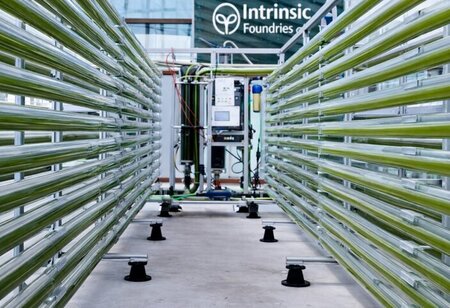
Intrinsic Foundries, a carbon-to-value biomanufacturing platform, has raised Rs 12 crore (about $1.4 million) in a seed round headed by Transition VC.
Key Highlights
- Intrinsic Foundries raises ₹12 crore seed funding to accelerate product development, market expansion, and operational scaling.
- The round led by Transition VC strengthens the startup’s growth strategy and technological innovation roadmap.
According to a news statement from Intrinsic Foundries, the money will be used to scale engineering and commercial teams, file intellectual property, conduct industrial pilots, increase research, improve manufacturing capabilities, and create a US company to assist the growth of international markets.
Intrinsic Foundries, a carbon-to-value biomanufacturing platform founded in 2023 by Shreyansh Jain, Sanjay Jain, and Umang Jain, uses integrated automation, modular photobioreactors, and proprietary microbial biorefinery systems to transform industrial emissions, effluents, and residues into high-quality biochemicals. The business provides sustainable ingredients and materials to a variety of international sectors while facilitating scalable, revenue-positive decarbonization.
Utilizing biological systems, the Hazaribagh-based firm transforms emissions into vital product inputs and new revenue streams by turning collected carbon into high-value biochemicals used in the food, pharmaceutical, nutraceutical, cosmetic, agricultural, and advanced material industries.
Intrinsic Foundries claims to have created a carbon biorefinery platform that is based on in-house photobioreactor culture systems that have Factory 4.0 automation built in. While it continues to explore various microbial biorefineries, such as yeast-based systems, its primary focus is on microalgae-based biorefineries for industrial carbon emissions.
Also Read: HomeRun Raises $6.6 Million to Scale Quick Commerce for Construction
Last year, Intrinsic asserted that it had successfully finished a Proof of Concept at a thermal power plant, proving extended continuous capture with operational reliability. Through collaborations with business associations, it is promoting commercial participation in the food, pharmaceutical, steel, cement, and nutraceutical industries.
The company intends to operationalize its first one-ton-per-day commercial plant and commission several industrial pilots over the course of the following 12 to 24 months. As a first step toward worldwide industrial decarbonization, it seeks to build infrastructure for carbon-to-value biomanufacturing. The business wants to show that emissions may drive sustainable supply chains and yield quantifiable financial gains.