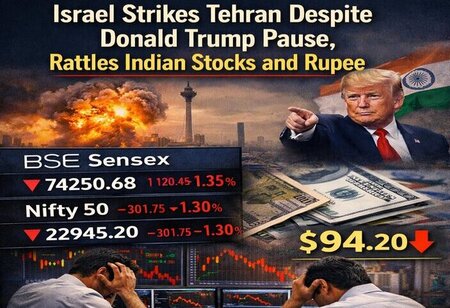
Escalating tensions in West Asia intensified after Israel’s military said it had conducted a wave of strikes “in the heart of Tehran,” even as Donald Trump extended the deadline on attacks on Iranian energy infrastructure by 10 days until April 6. The developments have continued to rattle financial markets, with a sharp impact on Indian equities and the rupee.
Key Highlights
- BSE Sensex and Nifty 50 fall sharply as Iran conflict rattles investor sentiment.
- Indian rupee hits record low past Rs 94 amid rising oil prices and FII outflows.
Indian stock markets witnessed a steep sell-off, mirroring global risk aversion. The Sensex fell over 1,000 points (around 1.3–1.4%) Trading around 74,200–74,330 levels, while the Nifty dropped below the 23,000 mark, as investors reacted to persistent geopolitical uncertainty and elevated crude oil prices above $100 per barrel. Broader markets were hit harder, with mid-cap and small-cap indices declining, and overall market sentiment turning decisively risk-off.
Since the conflict began in late February, benchmark indices have already corrected by over 7–8%, highlighting sustained pressure on equities. The sell-off has also wiped out approximately Rs 5 lakh crore in investor wealth in a single session, underscoring the scale of the market reaction.
The Indian rupee has been hit even harder, plunging to a record low beyond Rs 94 per US dollar, amid rising oil prices, foreign fund outflows, and global dollar strength. The currency has already weakened about 3.5% since the conflict began, reflecting mounting pressure on India’s external balances due to its heavy dependence on crude imports.
Also Read: BSE SmallCap 250 Set for Its Longest Quarterly Slide Since Dec 2011
Analysts say the dual impact stems from rising oil prices and global uncertainty. Higher crude prices increase India’s import bill and inflation risks, while geopolitical instability triggers foreign investor outflows—putting pressure on both equities and the rupee.
“Even though oil prices have eased slightly after the US pause, markets remain driven by uncertainty rather than fundamentals,” said a market expert. “Until there is clarity on the conflict, volatility in both stocks and currency is likely to persist.”
Overall, while the temporary pause in attacks has provided limited relief to oil markets, its impact on Indian equities and the rupee remains negative, with investors continuing to adopt a cautious stance amid evolving geopolitical risks.