
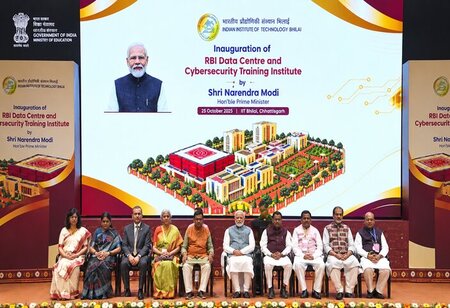
PM Modi has highlighted banking reforms, financial inclusion initiatives and cybersecurity preparedness while inaugurating the Reserve Bank of India’s (RBI) new Data Centre and Cybersecurity Training Institute in Bhubaneswar, Odisha. The Rs 169-crore facilities, inaugurated on October 25, are intended to strengthen critical financial infrastructure as India’s reliance on digital payments and technology-enabled banking continues to grow.
Key Highlights
-
PM Modi highlighted Jan Dhan accounts, direct benefit transfers and Mudra loans while discussing India’s banking reform.
-
The RBI’s Rs 169-crore Bhubaneswar facilities aim to strengthen critical payment systems, cybersecurity training and financial infrastructure.
In the context of the overall transformation of the Indian banking industry, PM Modi discussed various measures implemented to increase access to formal financial services, including Pradhan Mantri Jan Dhan Yojana, Mudra loans, and direct benefit transfers (DBT). He also highlighted the need to safeguard digital systems against new cyber risks.
PM Modi Highlights Jan Dhan Yojana and Direct Benefit Transfers
PM Modi spoke about the banking environment prior to 2014 and the growth of digital banking and financial inclusion over the last few years. He pointed to Jan Dhan accounts and direct benefit transfers as important steps to promote access to banking system and ensure that government assistance reaches the intended beneficiaries.
The Jan Dhan initiative has introduced millions of people to the formal banking system, and DBT allows eligible government benefits to be directly deposited into the account of the beneficiaries. This is aimed at cutting out intermediaries and enhance the provision of public support.
Union Finance Minister Nirmala Sitharaman, speaking after the inauguration, said more than 59 crore Jan Dhan accounts had been opened. She also highlighted the role of direct transfers in improving the delivery of government benefits.
Mudra Loans Extend Credit to Micro and Small Entrepreneurs
PM Narendra Modi also mentioned about the contribution of Mudra loans towards economic empowerment. The Pradhan Mantri Mudra Yojana has been introduced to help the entrepreneurs in accessing the institutional credit in order to carry on the business activity and growth.
Through more than 60 crore collateral-free loan accounts, over Rs 43 lakh crore has been sanctioned under the scheme, FM Sitharaman said. It also benefited more than 65% women, she added. The numbers underline the volume of lending this programme has undertaken and how it is helping to provide formal credit to smaller enterprises.
However, access to a bank account does not automatically guarantee a loan or eligibility for a particular government benefit. Credit and welfare assistance remain subject to the conditions of the relevant scheme and, where applicable, the lender’s assessment.
RBI’s Rs 169-Crore Data Centre to Support Critical Payment Systems
The RBI’s newly inaugurated Data Centre and Cybersecurity Training Institute are located at Info Valley-II in Jatni, near Bhubaneswar. The facilities are spread out over 18.55 acres, and are designed to bolster the central bank's technology infrastructure and build the resilience of vital financial services.
The data centre will support mission critical payment and settlement systems like the Real Time Gross Settlement (RTGS) and National Electronic Funds Transfer (NEFT) systems. According to RBI Governor Sanjay Malhotra, the facility would help enhance the service uptime, downtime minimisation and bring robustness to the financial system.
The centre is Uptime Institute Tier IV accredited and will offer a secure, resilient and scalable computing environment. Its location, away from the central bank’s existing data centres in Maharashtra, also supports geographical diversification and operational resilience.
Also Read: Banking Liquidity Surplus Hits Rs 9.71L Cr Driven by FCNR-B Inflows
Cybersecurity Becomes a Priority as Digital Banking Expands
With increasing digitalization of banking services, cybersecurity has emerged as a major concern for financial institutions. Attackers can cause disruption to the service, invade customers' finances through threats like phishing, account takeovers, malware, and attacks on critical systems.
The Cybersecurity Training Institute will be used to train, research and develop capabilities for RBI staff and the financial industry. Cyber security, artificial intelligence, big data analytics, quantum technology and blockchain are its focus areas. The program aims to enhance the competencies required to safeguard financial systems and cope with emerging technology-related threats.
With digital banking growing, the increase of account access and payment services is not enough. Good infrastructure, educated cybersecurity experts, and prompt redressal of customer complaints are also key to maintaining public trust in digital financial services.
What India’s Banking Reforms Mean for Customers
The programmes announced by PM Modi have three interlinked aspects – formal bank access, access to entitled benefits of government programmes and infrastructure for DnF services.
These are positive steps for customers and further reinforce the key messages that they should seek out formal banking options and take basic precautions. One-time passwords (OTPs), PINs or banking passwords should never be given by the customer and any request for payment should be confirmed before it is authorised. If you think you have been a victim of digital payment fraud, please notify your bank as soon as possible and inform the relevant authorities.
Financial inclusion has helped to increase access to finance and banking, but the next step also relies on the sustainability and security of the underlying systems. For India's financial sector, which is becoming more technology-oriented, the new facilities introduced by the RBI aims to bolster that foundation.