
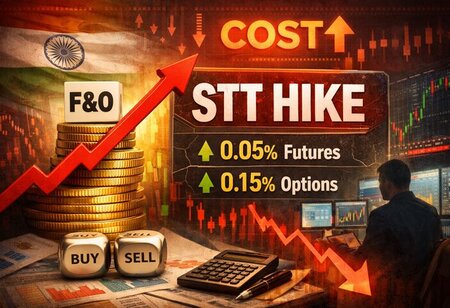
The government’s decision to increase the Securities Transaction Tax (STT) on futures and options (F&O) in Budget 2026 is set to make derivatives trading more expensive from April 1, triggering concerns among market participants over higher transaction costs and potential impact on trading activity.
Key Highlights
- STT hike increases trading costs, impacting F&O volumes and strategies for retail and high-frequency traders.
- Experts warn higher transaction tax may reduce liquidity and affect derivatives market participation in near term.
The revised structure raises STT on futures from 0.02% to 0.05% and on options premium to 0.15%, significantly increasing the cost of executing trades, especially for high-frequency and retail participants who rely on thin margins.
Shrey Jain, CEO, Stocko by InCred Money, said the move came as a surprise to some sections of the market and will directly impact trading behaviour. “The increase in STT announced in the budget and becoming effective from April 1 did come as a surprise to some market participants. Hike will impact retail and high-frequency traders as their transaction cost will go up substantially. Transaction cost changes may influence certain trading strategies at the margin; the broader participation trend remains intact.”
Market experts believe the hike could weigh on derivatives trading volumes in the near term. Aditya Agrawal, Chief Investment Officer at Avisa Wealth Creators, noted that the increase may affect sentiment amid already volatile market conditions. “The STT hike on derivatives may weigh on trading volumes and near-term sentiment amid volatile markets.”
Similarly, Pranav Haridasan, Managing Director & CEO at Axis Securities, raised concerns about liquidity and effectiveness of the measure. “Futures are a margined, risk-managed product and not typically the primary source of retail excess, which raises questions on whether higher STT will deliver the desired outcome or instead weigh on liquidity.”
Adding a contrasting perspective, Nithin Kamath, Co-founder and CEO of Zerodha, questioned whether the tax hike would achieve its intended objective of curbing speculation. “If the goal was to reduce speculative activity in F&O, then I’m not sure this will do anything.”
He also pointed out that the impact of the hike is uneven, as most trading activity is concentrated in options, which are less affected relative to futures.
Also Read: Form 130 to Replace Form 16 from April 1: What Taxpayers Need to Know?
Industry participants broadly agree that while the hike may increase government revenues and potentially discourage excessive speculative trading, it also raises the breakeven threshold for traders, particularly impacting high-frequency strategies and arbitrage models.
In the near term, traders are expected to reassess strategies, reduce turnover, or shift focus to alternative segments. However,long-term investors are unlikely to be significanntly affected, as the STT hike applies primarily to derivatives trading.