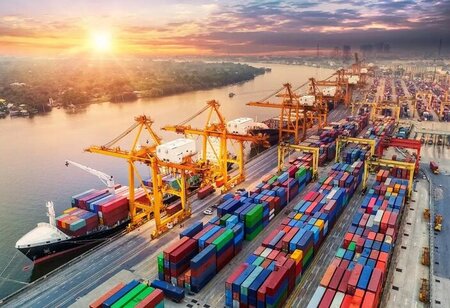
India’s trade deficit widened sharply to $28.38 billion in April 2026, reflecting growing pressure on external trade as escalating conflict in West Asia disrupted shipping routes, raised crude oil costs, and impacted export flows across key regional markets.
Key Highlights
- India’s trade deficit widened sharply as West Asia conflict disrupted exports and energy imports.
- Services exports stayed resilient while subdued gold imports helped partially contain overall external trade pressure.
According to provisional data released by the Ministry of Commerce and Industry, India’s merchandise exports rose to $43.56 billion in April, up from $38.92 billion in March, while imports surged to $71.94 billion, compared to $59.59 billion in the previous month. The widening trade gap highlights the growing strain on India’s external balance as geopolitical tensions continue to unsettle global supply chains and energy markets.
West Asia Exports Decline Amid Hormuz Disruptions
India’s trade exposure to West Asia remained under severe pressure during the month. Exports to the region declined 28% year-on-year to $4.16 billion, down from $5.78 billion in April 2025, while imports from West Asia dropped 31.64% to $10.47 billion, compared with $15.32 billion a year earlier.
The prolonged disruption around the Strait of Hormuz, one of the world’s most critical crude shipping corridors, continues to weigh heavily on trade activity after the ongoing Iran-linked conflict sharply reduced cargo movement through Gulf routes.
The conflict has significantly impacted India, the world’s third-largest crude oil importer and consumer, which depends on imports for over 80% of its crude oil requirements and nearly 60% of cooking gas consumption, much of it sourced from the Middle East.
Global crude prices have climbed to nearly $120 per barrel since the conflict escalated in late February, raising concerns over imported inflation, higher freight costs, and broader macroeconomic pressures.
Also Read: Indian Trade Deficit Falls to $20.67 Billion in March 2026
Services Trade Offers Stability
Despite weakness in merchandise trade, India’s services exports remained resilient at $37.24 billion in April, while services imports stood at $16.66 billion, helping narrow the overall trade deficit, including services, to $7.81 billion, compared to $11.16 billion in the same period last year.
Total exports, including merchandise and services, rose to $80.80 billion, up from $71.13 billion a year ago, while total imports increased to $88.61 billion from $82.29 billion.
This continued strength in India’s services sector remains a key buffer against external trade volatility and supports the broader current account outlook.
Government Sharpens Export Push
India closed FY26 with total exports at a record $860.1 billion, reinforcing its ambition to achieve $2 trillion in exports by FY31, split evenly between merchandise and services.
To meet this target, the government has directed officials to strengthen support for MSMEs, agricultural exports, certification reforms, and Brand India promotion across global markets.
RBI Governor Sanjay Malhotra recently said India’s expanding network of bilateral and regional trade agreements is expected to boost trade opportunities, diversify export destinations, and deepen integration into global value chains.
Gold Imports Near 30-Year Low
India’s gold imports are estimated to have remained near a three-decade low in April, after banks halted fresh purchases following tighter import restrictions and compliance measures introduced to conserve foreign exchange reserves.
The subdued bullion inflows may have partially offset the broader rise in merchandise imports, helping prevent an even wider trade imbalance.
The government recently increased import duty on gold and silver as part of a broader effort to contain non-essential imports and defend the rupee amid rising external pressures.
MSMEs Face Freight Cost Pressure
Exporters, particularly micro, small and medium enterprises (MSMEs), continue to face rising freight costs and shipment delays as cargo rerouting through alternative maritime channels increases transportation expenses.
MSMEs account for nearly 48% of India’s total exports, making their resilience critical to sustaining trade momentum during prolonged global disruptions.
Analysts say India’s trade outlook in the coming months will depend heavily on energy market stability, geopolitical developments in West Asia, and the pace of recovery in global shipping logistics, all of which remain key variables for the country’s external sector performance.