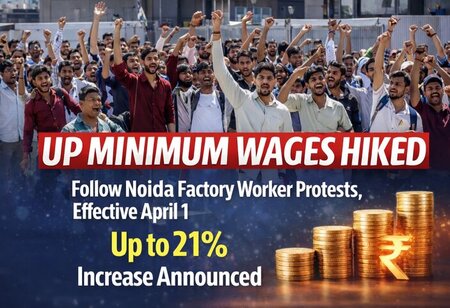
UP Govt has announced an interim hike in minimum wages across worker categories, following protests by factory workers in Noida over low pay and rising living costs.
Key Highlights
- Uttar Pradesh raises minimum wages up to 21% after Noida protests by thousands of workers.
- Revised wages effective April 1 aim to balance worker demands and industry economic challenges.
Under the revised structure, workers in key industrial districts such as Gautam Buddha Nagar and Ghaziabad will see a significant increase in wages. Unskilled workers’ monthly wages have been raised from Rs 11,313 to Rs 13,690, while semi-skilled workers will now earn Rs 15,059, up from Rs 12,445. Skilled workers’ wages have increased to Rs 16,868 from Rs 13,940, reflecting an average hike of around 20–21% across categories.
The wage revision varies across regions. In municipal corporation areas, unskilled workers will receive Rs 13,006 per month, semi-skilled workers Rs 14,306, and skilled workers Rs 16,025. In other districts, the revised wages stand at Rs 12,356 for unskilled workers, Rs 13,591 for semi-skilled workers, and Rs 15,224 for skilled workers, ensuring broader coverage across the state’s workforce.
Noida Protests Trigger Wage Revision Move
The decision comes in response to ongoing protests by factory workers in Noida Phase 2, where workers have been demanding better wages and working conditions. Protesters have highlighted that existing pay levels are insufficient to meet basic expenses such as rent, food, and daily essentials, especially amid rising inflation and global economic pressures linked to geopolitical tensions in West Asia.
In its statement, the state government acknowledged the concerns raised by workers, noting that “the problems and demands raised by workers are relevant, important, and worth considering.” At the same time, it emphasised the need for a “balanced and harmonious approach” between industry and labour, given that businesses are also facing challenges such as rising raw material costs and declining exports.
Wage Board, Policy Push and Future Outlook
The interim wage hike was approved by a high-level committee constituted under Chief Minister Yogi Adityanath. The government also announced that a formal Wage Board will be set up next month to finalize a comprehensive wage structure after consulting stakeholders, including labour unions and industry bodies.
Despite the announcement, protests have continued in parts of Noida, indicating that workers view the revision as a starting point rather than a final resolution. Security forces remain deployed in sensitive areas following earlier incidents of unrest, underscoring the ongoing tensions between workers and employers.
Also Read: India's New Labor Codes 2026: Impact on Salary, PF, and Work Culture
The government has also issued a warning against misinformation circulating on social media regarding minimum wages, clarifying that claims suggesting a Rs 20,000 minimum wage are “false and fabricated.” Authorities have urged citizens to rely only on official sources for accurate updates.
The wage revision comes at a time when India is moving toward implementing a national floor wage under new labour codes, aimed at ensuring a uniform baseline for worker compensation across states. The Uttar Pradesh government stated that its decision aligns with this broader objective of ensuring fair and just remuneration for workers, while maintaining economic stability.
In addition to wage hikes, Chief Minister Yogi Adityanath has directed employers to ensure compliance with labour laws, including timely wage payments, overtime compensation, weekly holidays, bonuses, and social security benefits. He also emphasised the importance of ensuring safety and dignity for women workers at the workplace.