
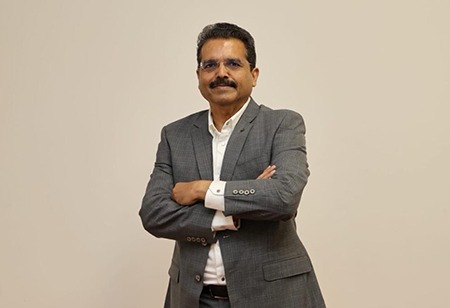
In an exclusive interaction with Thiruamuthan, Correspondent at Finance Outlook India, Rajneesh Jain, President & CFO, Reliance Jio Infocomm Ltd, discusses how finance leaders are balancing digital scale, cost efficiency and capital investment amid evolving business priorities. He also shares his perspectives on financial strategy, AI adoption and the changing role of CFOs.
Rajneesh Jain is a seasoned finance leader with nearly four decades of experience spanning financial management, commercial operations, business strategy and business development. His professional journey includes leadership roles across Reliance Group, Reliance Communications, Indo Rama Synthetics and Bharat Heavy Electricals Limited, alongside multiple industry recognitions, including the CII CFO of the Year award.
How can finance leaders challenge investment decisions without slowing down the technology and growth priorities that keep a business competitive?
The best time to challenge an investment is while it is still an idea, not when it arrives for approval. A CFO who turns up at the final gate with ten new questions has already cost the project weeks. A CFO who sits in the room at the start seldom has to say no.
Three habits have served me well. First, settle the guardrails beforehand: how much capital a project may consume and how quickly it starts giving returns.
Second, treat reversible and irreversible decisions differently. A pilot project can be cleared in days. However, a commitment that binds us for years deserves a long, hard argument.
Third, the conversation shifts from defending a number to testing an assumption, and technology teams welcome that.
The aim is never fewer investments. It is a quick yes where the economics are sound, and supporting them where they are not.
The real test of capital allocation is not how much a business invests, but whether each successive rupee creates more value than the last
How should CFOs approach capital allocation when investing in large platforms, infrastructure and emerging technologies?
This is normally done by separating two kinds of capital: Core infrastructure, capacity and compliance are the price of staying in the game. New products and services must earn their place with a clear return.
Then comes sequencing. Large investments front-load the spending, and returns arrive only as adoption and utilization build. I would look at the whole curve, including the point where capital intensity falls and free cash flow rises, and not judge a project on its first year.
Finally, release money against proof, not ambition. Fund the next tranche once the last one is visibly working.
What financial KPIs should companies track to measure growth, operational efficiency and long-term value creation?
The risk is rarely too few measures. It is too many. I prefer a short list, in four groups, where every measure has an owner and informs a decision.
On growth, one should review customer growth, customer retention and revenue per customer. The mix matters as much as the total, since the customers and segments that stay longest are usually the ones worth most.
On capital, I track capex intensity, return on capital employed and free cash flow. Return on incremental capital is the sharpest test of all, because it tells you whether the next rupee works as hard as the last.
On the balance sheet, net debt to EBITDA, interest cover and the cost of funds keep us honest.
What role can AI, automation and data analytics play in transforming the finance function?
A digital business starts with a rare advantage. It generates vast amounts of clean, granular, time-stamped data. The real question is whether finance is willing to use it.
I think of the answer as three As: automation, analytics and AI. Automation takes over the routine work of matching invoices, reconciling accounts and booking accruals. Analytics uses the time saved to show what the numbers mean, such as cost to serve and operating margin. AI then helps finance look ahead, through rolling forecasts, early warning on anomalies, and the detection of fraud and revenue leakage.
The real gain lies in how finance spends its time. In many organizations, around two-thirds of the effort still goes into processing transactions and very little into supporting decisions. The best finance teams have turned that around. That, far more than any saving in headcount, is the return on AI.
I would add three things. Fix the data first, because automation on poor data only delivers wrong answers faster. Keep people accountable for judgment, and keep an audit trail behind every number a model produces. And invest in your team, because tomorrow's finance professional must be able to question a model, not merely run a ledger.
Get this right and the month-end closing becomes continuous, the forecast stays live, and the CFO's conversation with the stakeholders turns to improvement areas.
How is the role of the CFO changing as businesses evolve into broader digital ecosystems?
I have often described the CFO as four people in one: the Strategist, the Catalyst, the Steward and the Operator. As businesses grow into wider digital ecosystems, each of these jobs gets bigger, and the CFO has to move between them within a single day.
The Strategist ensures capital across businesses with very different economics. Infrastructure-led businesses are capital-heavy and steady, much like an annuity. The Catalyst works alongside the business on delivery, not only at the approval stage. The Steward protects the integrity of data and answers for privacy, cyber risk and compliance, which now carry real balance-sheet consequences. The Operator keeps the cost of serving customers falling even as the offering widens.
Finance used to report on the business. Today it is expected to help shape it.
Which capabilities will future finance leaders need to develop as the expectations from the finance function continue to expand?
Four capabilities stand out, and I would rank them by how often they are underestimated.
First, technical and commercial fluency. A finance leader should understand how the business actually works: how the technology is built, how it scales and how a product makes its margin. Engineers and product teams respect those who speak their language, whatever the title.
Second, comfort with data and AI. Not coding for its own sake, but the ability to ask the right question, test a model's assumptions and push back on an answer that looks too neat.
Third, depth in risk and governance: cyber, data protection, regulation and sustainability. These now sit squarely within finance.
Fourth, and the most important, the ability to build people. No CFO can be a strategist while carrying the transactional load alone. A strong second line, young leaders with fresh ideas and a culture that rewards high performance, is what earns finance its seat at the strategy table.
Editor’s Note:
Jio Platforms, the parent company of Reliance Jio Infocomm, achieved a historic milestone in October 2026 with India’s largest-ever IPO, raising ₹30,188 crore through a 100% fresh issue and surpassing Hyundai Motor India’s 2024 record. The offering attracted bids worth ₹7.4 lakh crore and was subscribed over 21 times. It was fully subscribed within 100 minutes and received a record 1.39 crore applications. On listing, the shares debuted at ₹1,358, a 21.36% premium over the issue price, valuing the company at ₹12.5 lakh crore and making it India’s second-most-valuable listed company.