
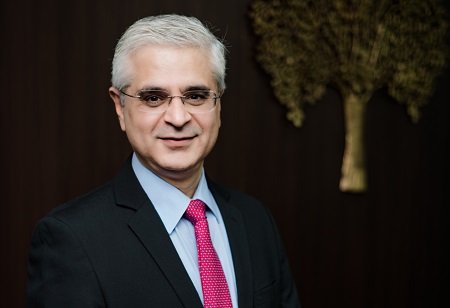
In an exclusive interaction with Thiruamuthan, Correspondent at Finance Outlook India, Tarun Chugh, Managing Director & CEO, Bajaj Life Insurance, discusses how the growing adoption of artificial intelligence in India's life insurance industry is shaping customer experience. He also shares his insights on improving insurance protection, expanding distribution beyond major cities, strengthening policyholder trust and balancing digital capabilities with human advice.
Tarun Chugh, a seasoned leader, brings over 30 years of experience, including more than two decades in the life insurance sector. He has held leadership positions at Bajaj Life Insurance, PNB MetLife and ICICI Prudential Life Insurance. His professional experience spans business leadership, investment banking, distribution strategy and organizational transformation, with a focus on sustainable growth and long-term value creation.
As AI adoption advances across financial services, how are Indian life insurers applying it to underwriting, personalization, fraud detection and claims servicing, and where does implementation still fall short?
AI is now an integral part of life insurance operations. At Bajaj Life, close to 80 percent of medical test reports are processed using AI, helping underwriters assess risks faster. AI also supports KYC and income-document checks, while technology enables automated verification of death certificates for around 40 percent of claims.
The next opportunity lies in personalized guidance and proactive servicing. Our multilingual Gen-AI voice assistants support customer conversations, while tools such as Smart Coach and Smart Pitch equip our sales teams across 11+ regional languages.
Challenges around data privacy, integration, reliability and governance remain. AI must strengthen human judgment, not replace it - particularly when decisions affect a family's financial security.
The success of India's life insurance industry should ultimately reflect the financial security created for families rather than the number of policies sold
Despite India's insurance ambitions, what structural barriers prevent households from obtaining adequate life cover, and how must products, pricing, financial awareness and distribution evolve to achieve “Insurance for All by 2047”?
The challenge is not just access to insurance, but adequacy of protection. Retail life cover typically stands at Rs 5–6 lakh, while MFI/PMJJBY covers are around Rs 0.5–2 lakh. These amounts may be insufficient to replace income or secure a family's long-term needs. Ideally, life cover should be linked to income, with protection of at least 10 times annual income.
Bridging this gap requires simpler products, flexible pricing, stronger financial awareness and distribution suited to local needs. The GST exemption on individual life insurance premiums is also a meaningful step towards affordability. For a 35-year-old purchasing cover up to age 75, the savings can be equivalent to seven premiums.
At Bajaj Life, around half our business comes from beyond the top 50 cities. Reaching the 2047 goal -‘Insurance for All’ - will require us to expand access while ensuring customers have adequate cover.
As online insurance journeys expand, how should life insurers integrate digital self-service, advisors and bancassurance partners to simplify complex policy decisions while preserving informed choice and long-term customer trust?
Digital platforms make insurance more accessible, but life insurance remains a long-term decision that often requires personalized advice. Digital channels can simplify onboarding and servicing, while advisors and bancassurance partners help customers understand their needs and choose suitable solutions. The two must complement each other.
At Bajaj Life, we are strengthening agency, partnerships and digital distribution together. We equip our distributors with tools such as InstaLearn, AI-powered Smart Coach and Smart Pitch. Our WhatsApp bot also makes common service requests easier to access. Combining digital convenience with local-language support and trusted advice is especially important in smaller towns and rural markets.
In a long-term protection business, how can insurers use technology to improve policy transparency, persistency, grievance resolution and claims experiences, making policyholder trust measurable throughout the policy lifecycle?
Trust in life insurance is built throughout the policy lifecycle, not just at the point of sale. Persistency, service responsiveness, grievance resolution and claims experience are important indicators of how well insurers honor their commitments.
At Bajaj Life, multilingual voice assistants help customers access support in their preferred language, while automated document verification helps simplify claims processes.
Technology can make insurance easier to understand, maintain and access when it matters most. Ultimately, these customer outcomes must be measured as closely as business growth.
Having transitioned from investment banking to life insurance leadership, how has your approach to capital allocation, risk management and long-term value creation evolved, and which strategic investments matter most?
My experience across financial services has reinforced the importance of balancing growth with prudent risk management. In life insurance, this is particularly important because our commitments to customers can extend over decades. Capital allocation must therefore support financial resilience and sustainable profitability.
At Bajaj Life, our investments focus on three priorities: protection-led offerings that address evolving customer needs, technology and AI to improve underwriting and servicing, and stronger distribution across agency, partnerships and digital channels. The objective is to build a resilient business that creates lasting value for customers, distributors and shareholders.
Looking ahead, how do you see India's life insurance industry evolving over the next five to ten years, and what strategic shifts will drive sustainable growth and expand insurance protection?
India's life insurance industry has significant long-term potential. With penetration at 2.7 percent in FY2024–25, expanding access and improving the adequacy of protection will remain important priorities. As customer needs evolve and people live longer, demand for protection, long-term savings and retirement income solutions will also grow.
Three shifts will shape the next phase: more relevant and affordable products, deeper distribution in underserved markets, and technology-led improvements in underwriting and servicing. AI will play an important role, while human advice and trust will remain essential. Ultimately, success should be measured not just by policies sold, but by the financial security created for Indian families.