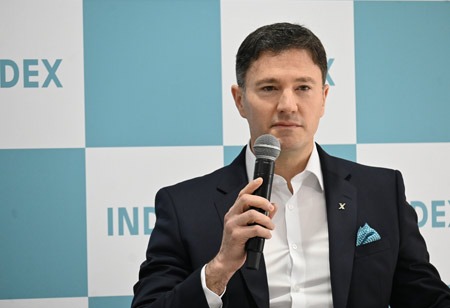
In an exclusive interaction with Adlin Pertishya Jebaraj, Correspondent at Finance Outlook, Roberto Deger, Member of the Management Board & CFO, CHRO at INDEX Group, notes that the world is changing its approach to financial planning and investment practices in response to rising interest rates and geopolitical uncertainties. He highlights the increasing demand of orderly, dependable financing products and responsive decision making models to manoeuvre through turbulent market environment.
Roberto Deger is an experienced financial executive, with vast experience of working in the global finance, risk management, and strategic leadership within industrial and manufacturing enterprises. Deger has worked across the forecasting, investment strategy and cybersecurity resilience, but aligning technological innovation with sound financial structures.
What are the most significant trends or developments currently impacting the financial market?
The phenomenon we are witnessing shaping the financial market is, of course, the development of interest rates. Following the financial crisis, we got used to extremely low interest rates over a long period of time. Financing is now a much more important factor for customers with rising rates. Structured and reliable financing solutions are vital in this environment. INDEX gives the solution to finance the customers, which would help them better navigate the new interest rate environment.
The introduction of tariffs by the US government is another development, as it puts the current free trade agreements to the test and raises questions. This provides an element of uncertainty to international markets and international business. But as Germans and Europeans, we still have the belief that international trade is one of the success factors in global economic development. Here, I am especially delighted that there is a free trade agreement currently existing between the European Union and India. We take it as a good basis of a long-term cooperation and further economic cooperation.
What is your perspective on balancing the adoption of cutting-edge technologies with ensuring strong cybersecurity and data protection in the financial sector?
It is a very important question. We are operating in a very robust regulatory environment in Europe, particularly in Germany. There is strict adherence to rules and regulations. The resources and huge financial contributions are meant to assure us that we are on par with the requirements of the law. Regarding data protection and cybersecurity, there is the emergence of a new European directive that advises companies to come up with extensive business continuity measures and cybersecurity strategies.
Although we are naturally expected to do it because it is necessary, and mostly do it in order to protect ourselves. We have a great amount of knowledge and know-how, which needs protection. In addition, those are highly IT-based production systems and business processes. This renders the necessity of a robust IT architecture and a safe cyber space. The nature of protecting the systems is not merely regulatory compliance but also to guarantee continuity of the operational systems and financial stability in the long term.
What adjustments might be needed in areas like investment portfolios, risk management, or financial planning?
The changes that we have to make in terms of investment planning are the direct results of the evolving geopolitical landscape and the heightened degree of uncertainty that we are witnessing in the world. In this case, we must make our investments to have shorter payback periods.
Long-term investment decisions are still possible, although it is now more difficult to establish business plans for a period of ten years. Under certain circumstances, we are barely able to guess what will occur in the next several months- especially in the United States at the moment. Such instability of mind needs a new approach.
This has led to the nature of agility and flexibility being made a core part of the planning and investment process. This will enhance the organizational ability to respond fast to new changes, re-evaluate the risks, and modify strategies when required.
Also Read: How Conversational AI Is Reshaping Financial Services
How do you stay updated on the latest trends and developments in financial market regulations and technologies?
The main forms of updates include the power of a strong professional network. Also, building an extensive relationship with a strong network of banks that has been doing business over the years. Through these alliances, one gets insightful information on the trends in the financial market.
Interact with sparring partners in the industry and different segments of the customers. In the constant communication, we evaluate how well we agree in the way we interpret the economic events and the most significant trends that characterize the market. This interchange of views assists us to stay in line with the thinking in the industry and predict the new developments.
Looking ahead, what key trends or developments do you believe will fundamentally reshape the financial industry over the next decade?
There is a high likelihood of witnessing numerous revolutionary changes, yet the role of artificial intelligence will certainly be characterized. The artificial intelligence will have a powerful influence on accounting, controlling, reporting, and financial analysis. It will radically transform how we track performance, understand KPIs and strategic decisions.
The use of AI-based tools will improve data processing, accuracy of forecasting, and make better decisions. Its impact on the processes of financial management will be huge and far-reaching in the coming decade.