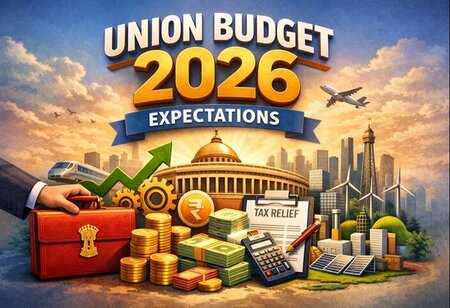
As Finance Minister Nirmala Sitharaman prepares to present the Union Budget 2026-27 on February 1, 2026, India stands at a critical juncture in its economic transformation journey. This budget will be able to reconcile fiscal tightening and growth stimuli as well as meet the demands of the different stakeholder groups given that the economy has proved to remain stable in the face of global uncertainties and the government is keen to pursue its Viksit Bharat vision.
Macroeconomic Environment and Fiscal Objectives
The economic trajectory of India has been better in FY 2025-26 and the Reserve Bank of India and Asian Development Bank has forecasted the growth at around 7.3% and 7.2% respectively after an impressive first-half real growth in GDP was recorded at 8%. Even with worries regarding the depressed inflation rates that would result in reduced nominal GDP growth that would have some consequences on Budget 2026 fiscal aggregates, analysts still have hope concerning fiscal management.
The fiscal deficit in 2025-26 is set at 4.4 percent of GDP compared to the revised forecast of 4.8 percent in 2024-25. PwC analysis has it that India will achieve and maybe even surpass this target, with the deficit likely to be reported at 4.3% even with the expected shortcomings in tax revenue. The government has a good record of fiscal discipline that gives hope of accomplishing such consolidation objectives.
Personal Income Relief and Tax Reforms
The Budget 2026 is one of the most expected events, focusing on the changes in personal income taxes. The middle class, a major contributor to India’s tax base, wants significant tax relief to increase disposable income and spending. Offers are to extend the intermediate slabs by 5, 10 and 15 percent of the amount paid on the rates of up to 4-8 lakh, 8-12 lakh, and 12-16 lakh with a proposed 30 percent deduction on gross income, regardless of the limit, on term life, health insurance, pension products and small savings.
The new New Income Tax Act, 2025 that has been introduced to replace a 6-decade-old legislation has generated the anticipation of a comprehensive guideline and a transitioning mechanism. Tax experts point to the fact that there should be clarity to prevent any interpretational sides that may provoke lawsuits.
Access to Credit and Support of MSME
Micro, Small and Medium Enterprises are already the biggest sources of employment in India and one of the key areas on the agenda of Budget 2026. The industry organizations have pointed out the necessity of increasing and speeding up institutional credit access more so micro and small businesses and enhanced credit guarantee schemes to assist first time borrowers.
The government has already declared that they are going to raise credit guarantee cover to 5 crores of micro and small enterprises or 10 crores to 20 crores of other businesses. In addition to the possibility of access to credit, the MSMEs anticipate more simplified compliance processes of GST, fewer types of TDS, and aid in digital transformation to become more productive and competitive.
Technology and Manufacturing Push
The budget 2026 is likely to continue supporting domestic manufacturing in the project make in India. The new technologies like AI, robotics and high level automation are likely to get continued policy support, and the suggestions will be to extend the support to other areas of new-age technologies other than conventional manufacturing.
The Production-Linked Incentive plans will probably be spread to additional industries especially AI, deep-tech manufacturing, and digital infrastructure. Also, reintroduction of benefits on accelerated depreciation under the concessional corporate tax regime are expected to enhance efficiency of capital and capital investment.
Also Read: Finance Outlook 2026: Markets, Policy and the Road Ahead
Infrastructure and Capital expenditure
The government has incurred an amount of 6.2 lakh crore against a budgeted cap on capital expenditure of 11.2 lakh crore and capital expenditure increased by 32.4% in April-October FY26. The government will also ensure that its capital expenditure targets are achieved and this will continue to propel the infrastructure development as one of its major growth drivers.
Every ministry dealing with infrastructure will design a three years pipeline of projects to implement partnership with the private sector, and a second asset monetization plan will be initiated to be executed by 2030. This long term infrastructure emphasis is significant in the long run productivity improvement and economic development.
GST Rationalisation and reforms of Indirect tax
One of the themes that would feature in Budget 2026 is indirect tax reforms. The major expected steps will be the removal of Section 13(8)b of the IGST Act, which will change the location of supply of the intermediary services to be the location of the recipient instead of being at the location of the supplier in order to align the GST framework of India with the global tax principles.
The other notable anticipation that would enhance access to working capital by the concerned industries is the introduction of provisional refunds on cases of inverted duty structure. The simplification of GST compliance especially that of MSMEs is still a priority with hopes of relaxation of processes and simplification of returns.
Housing and Real Estate Sector Expectations
The property market foresees a number of reforms in being able to continue with the housing momentum. The industry leaders are of the view that Budget 2026 will likely make decisive contribution towards enhancing affordability due to maximising capital gain rationalization, restructuring of GST, green incentives and simplified access to credit. The redefining of affordable housing to reflect on the realities of the present market and the revision of the Rs 10 crore limit on the capital gains reinvestment are some of the important requirements.
Conclusion
Union budget 2026 comes at the time when India must strike fiscal moderation and growth imperatives. Considering the expectations on tax relief, infrastructure investment, support of MSMEs, and industry-specific incentives, the budget should meet the urgent needs of consumption and establish the grounds to transform the economy in the long-run. These measures will not only be successful by the announcement of the policy but their implementation that will translate into real benefits to households, businesses and the economy at large. The Budget 2026 is an essential step in the quest to make India the third-largest economy in the world, as the country takes a step to achieve this goal.