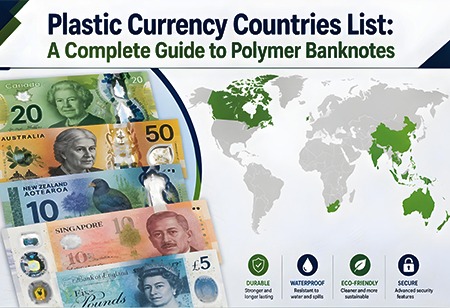
In 2026, more than 45 countries worldwide have already used polymer (plastic) banknotes, either fully or in part. In Australia, polymer notes were the first to be introduced in 1988, followed by the other countries, which have also introduced plastic notes in various denominations (some countries introduced them in all denominations). Other countries, such as Vietnam, Nigeria, Mexico and China, issue a handful of additional high-value or commemorative notes in polymer.
Plastic currency, also known as polymer banknotes, has quietly transformed how the world thinks about cash. The initial Australian bicentennial note of 1988 has evolved into a worldwide movement that has extended across continents, currencies and central banking philosophies. This guide explains which country banknotes are made of polymers, why they have replaced the traditional paper money, and how it affects the future of physical currency.
What is plastic currency?
What are PolyBanknotes?
Polymer banknotes are currency notes printed on a synthetic material (usually biaxially oriented polypropylene (BOPP)) instead of the usual cotton-linen combination found in paper banknotes. These notes are embossed with high level security features not found on regular paper notes like transparent windows, metameric inks and embedded holographic strips.
How is Plastic Notes made?
The polymer substrate is made by a few specialist firms, including CCL Secure (also an original Australian producer) and Innovia Security (also originally Australian), which is then licensed by the central bank of each country in the world for the manufacture of notes. It consists of applying opacifying layers to the BOPP film, printing security/holographic features, and onto this printing applying optically variable devices such as colour or pattern shifting depending on the viewing angle. The manufacturing process also enables central banks to print see-through windows directly into the note which is not possible with cotton-paper substrates.
Difference Between Paper Currency and Plastic Currency
Paper currency is produced from a cotton linen fibre mixture and plastic currency is produced from a synthetic plastic film. The differences are very real; plastic notes hold up well to water and moisture, last a long time in circulation, and are able to include security elements, such as transparent windows that paper notes can't match.
Why Do Countries Switch to Plastic Currency?
There are many reasons that central banks have found to be recurring reasons for the introduction of polymer notes:
- Durability studies used by encyclopedic sources indicate that polymer notes will last approximately 2.5 times longer than paper notes.
- Transparent windows, metallic strips and metameric inks make counterfeiting much more difficult.
- Reduce the total replacement expenses over time: although the initial printing expenses are high, the longer time that the book circulates, the lower the replacement expenses.
- Polymer notes are more waterproof than paper notes and can withstand washing machines, rain and humid environments.
- On a Hygiene basis, polymer's non-porous surface will keep less contaminants than paper's fibrous surface.
- At end of life the worn polymer notes can be recycled into household, building and industrial products.
Complete List of Countries That Use Plastic Currency
|
Country |
Year Introduced |
Current Status |
Currency |
|---|---|---|---|
|
Australia |
1988 |
Fully Polymer |
Australian Dollar |
|
Canada |
2011–2013 |
Fully Polymer |
Canadian Dollar |
|
United Kingdom |
2016 |
Fully Polymer |
Pound Sterling |
|
New Zealand |
1999 |
Fully Polymer |
New Zealand Dollar |
|
Romania |
1999 |
Fully Polymer |
Romanian Leu |
|
Papua New Guinea |
1991 (full switch 2008) |
Fully Polymer |
Papua New Guinean Kina |
|
Brunei |
2026 (new series) |
Transitioning to Fully Polymer |
Brunei Dollar |
|
Nigeria |
2007 |
Fully Polymer (Naira notes) |
Nigerian Naira |
|
Maldives |
2017 |
Fully Polymer |
Maldivian Rufiyaa |
|
Mauritania |
2017 |
Fully Polymer |
Mauritanian Ouguiya |
|
Nicaragua |
2017 |
Fully Polymer |
Nicaraguan Córdoba |
|
Vanuatu |
2017 |
Fully Polymer |
Vanuatu Vatu |
|
Eastern Caribbean States |
2019 |
Fully Polymer |
Eastern Caribbean Dollar |
|
Barbados |
2022 |
Fully Polymer |
Barbadian Dollar |
|
Singapore |
1990–1999 |
Mostly Polymer |
Singapore Dollar |
|
Vietnam |
2003 |
High Denominations Polymer |
Vietnamese Dong |
|
Mexico |
Gradual |
Mixed (select denominations) |
Mexican Peso |
|
Chile |
Partial |
Mixed |
Chilean Peso |
|
Malaysia |
Selected Notes |
Mixed |
Malaysian Ringgit |
|
Mauritius |
Partial |
Mixed |
Mauritian Rupee |
|
Fiji |
2013 |
Mixed |
Fijian Dollar |
|
Samoa |
Commemorative + circulation |
Mixed |
Samoan Tala |
|
Trinidad & Tobago |
Adopted |
Fully Polymer |
Trinidad & Tobago Dollar |
|
Jamaica |
Adopted |
Fully Polymer |
Jamaican Dollar |
|
Northern Ireland |
2000 (commemorative) |
Polymer (bank-issued notes) |
Pound Sterling |
|
China |
Commemorative |
Mixed (limited issue) |
Renminbi |
|
Russia |
Commemorative |
Mixed (limited issue) |
Russian Ruble |
|
Israel |
Selected Notes |
Mixed |
Israeli Shekel |
|
Hong Kong |
Selected Notes |
Mixed |
Hong Kong Dollar |
|
Saudi Arabia |
Selected Notes |
Mixed |
Saudi Riyal |
|
Brazil |
Commemorative |
Mixed (limited issue) |
Brazilian Real |
|
India |
Trial/Pilot |
Mixed (limited pilot notes) |
Indian Rupee |
"Mixed" status indicates the country has issued polymer banknotes for select denominations or commemorative purposes alongside continuing paper note circulation. As of recent industry estimates, more than 45 countries have issued polymer banknotes in some capacity, with the list continuing to expand through 2026.
Also Read: 10 Women-Led Fintech Startups Transforming India's Financial Landscape
Countries That Are Planning to Adopt Polymer Banknotes
Several central banks are actively moving toward full or partial polymer adoption. Brunei offers the clearest current example: the Brunei Darussalam Central Bank announced its first-ever complete polymer banknote series in September 2025, covering five denominations, with circulation beginning in the first half of 2026 - ending nearly six decades of paper currency in the country.
Countries like Hong Kong, Israel, Mexico, and Nigeria have reportedly been developing new banknote designs with greater polymer integration. Industry research also points to an expected wave of further adoption: some currency-industry analysts project that as many as 20 additional countries could transition away from pure paper banknotes by 2030, with particular momentum anticipated across the Middle East and parts of the European Union.
The decision to switch is typically driven by a combination of:
- Rising counterfeiting concerns with paper currency
- Central bank modernization initiatives tied to broader digital transformation strategies
- A desire to reduce long-term printing and replacement costs
Benefits of Plastic Currency
Longer Lifespan: Polymer notes have a lifespan of around 2.5-4 times longer than paper notes in circulation, minimizing the need for reprinting.
Counterfeit Protection: Polymer notes are significantly harder to counterfeit than cotton-paper banknotes because of their transparent windows, metameric ink and embedded security threads.
Waterproof: Polymer notes resist accidental washing, rain and high humidity environments without degradation; a primary reason tropical and island countries have been early adopters.
Hygienic: In terms of "cleaner and More Hygienic", the non-porous polymer surface has fewer bacteria and contaminants than paper notes due to its fibrous texture.
Environmentally Friendly: Polymer notes are longer lasting than paper notes, although they require more energy to manufacture, their use makes them less impactful across their entire life cycle, and old banknotes can be recycled into other plastic items.
Lower Printing Costs Over Time: Though the substrate is more expensive than paper, it saves on reprinting costs over the life of a note.
Disadvantages of Plastic Currency
- Higher initial production cost compared to traditional paper notes
- Slippery surface, which some users find harder to count or handle, especially when notes are new
- Heat sensitivity - polymer notes can warp or stick together under high heat (such as being left near direct sunlight or heaters)
- Recycling challenges - while technically recyclable, large-scale polymer note recycling infrastructure is still developing in many countries
- Public adaptation - consumers and cash-handling businesses often require an adjustment period when transitioning from familiar paper notes
Security Features of Polymer Banknotes
Polymer notes typically incorporate multiple layers of security technology:
- Transparent windows: clear windows printed right into the note, which are difficult to copy with regular printing.
- Holograms: shifting, multi-dimensional images visible at different angles.
- Microprinting: very small text, which is required to be magnified for easy reading.
- Raised ink (intaglio printing): tactile features used to help authenticate and access the print for someone who is blind.
- UV features: elements that fluoresce under ultraviolet light.
- Colour-changing inks: optically variable inks that change colour based on the angle of viewing.
- Embedded security strips: metallic or holographic strips visible when held to light.
The Bank of England's polymer £10, £20, and £50 notes - featuring Jane Austen, J.M.W. Turner, and Alan Turing respectively - showcase several of these features simultaneously, combining transparent windows with foil patches and raised printing for accessibility.
Plastic Currency vs Paper Currency
|
Feature |
Plastic Currency |
Paper Currency |
|---|---|---|
|
Lifespan |
2.5–4x longer |
Shorter |
|
Waterproof |
Yes |
No |
|
Counterfeit Resistance |
High |
Moderate |
|
Printing Cost |
Higher initially |
Lower initially |
|
Replacement Cost |
Lower over time |
Higher over time |
|
Environmental Impact |
Better over full lifecycle |
Higher due to replacement frequency |
|
Tactile Feel |
Smooth, slippery |
Familiar, fibrous |
How Polymer Currency Helps Reduce Counterfeiting
Unlike cotton-paper substrates, security features can be put in place during the manufacturing process of polymer. Printing the same window image with a standard ink jet or laser printer isn't consistently possible, meaning counterfeiters often wind up with a less than satisfactory print. Laser engraving and machine-readable security threads provide an additional security measure which is automatically verified by ATM and note counting machines, identifying any suspicious notes before they are released.
The UK's decision to use polymer was directly in response to the concerns over counterfeiting of the paper £20 note, which was the most counterfeited denomination before the change.
The Environmental Impact of Plastic Banknotes
The environmental argument for plastic currency is about life cycle not about raw material comparisons. Production of plastic banknotes is more expensive than polypropylene, however, due to the significantly longer circulation life, fewer banknotes are required to be produced, transported and destroyed over time. Often, plastic banknotes are shredded and disposed of in landfills or incinerated, but they can also be mechanically recycled to make other plastic products, like compost bins, plumbing fittings and industrial parts.
Which Countries Still Use Paper Currency?
The majority of the world's economies, including the United States, the Eurozone, and Japan, continue to use paper (cotton-based) currency. Common reasons for retaining paper notes include:
- Existing infrastructure investment - central banks with established cotton-paper printing facilities face significant capital costs to transition
- Lower printing volume requirements - some currencies don't justify the upfront cost of polymer substrate licensing
- Political and institutional caution - currency redesigns often require extensive legislative and public consultation processes
- Public familiarity - large, established economies sometimes prioritise continuity and public trust in existing note designs over technological upgrades
Frequently Asked Questions
Which country was the first to have plastic money? In 1988 Australia introduced its first true polymer banknote with a $10 note commemorating the 200th anniversary of the start of the British settlement in Australia.
Can plastic money be recycled? Yes. Banknotes made of polymer can be mechanically recycled to make household, building and industrial plastic products when they are worn.
What makes polymer banknotes better? They are much longer lasting, waterproof, dirt resistant and can include sophisticated security features such as transparent windows, which paper notes can not duplicate.
Is India a country that has plastic currency? As of 2026, India has not fully switched to polymer currency, despite having experimented with it in small denominations.
What country has all polymer banknotes? The fully polymer note families are used in Australia, Canada, the United Kingdom, New Zealand, Romania, Papua New Guinea, the Maldives, Nicaragua, Vanuatu, Barbados and a few of the Eastern Caribbean and Caribbean countries.
Does plastic money melt? Polymer notes are not melty when handled normally but will warp, shrink or adhere together at high temperatures.
Is the money made of polymer waterproof? Yes, polymer banknotes will be much more water resistant than paper banknotes and usually will last through a washing machine cycle without breaking apart.
What is the life of a polymer banknote? Polymer notes tend to circulate for 2.5 to 4 times as long as paper notes of the same value.
Why aren't polymer notes used in all countries? This is due to the high printing costs for the paper, the existing printing system, the reduced need for such a redesign due to already in place security features, and the political difficulty in redesigning the currency.
Are polymer notes more costly than paper notes? The upfront (initial) cost is higher than paper, but long circulation life can reduce overall replacement costs over time.
Final Thoughts
The adoption of plastic banknotes is part of a wider monetary policy trend aimed at improving the durability, security and sustainability of banknotes while ensuring the cost and disruption of currency changeovers are minimal. Looking ahead, expect continued expansion of polymer adoption, particularly among nations modernising their monetary infrastructure alongside broader digital transformation initiatives. At the same time, the rise of digital and mobile payments raises a longer-term question for all physical currency, polymer or paper alike: as cash usage gradually declines in many economies, will the substrate of banknotes matter as much in the decades ahead as it does today? For now, polymer currency remains the clear technological frontrunner for any country still relying significantly on physical cash.